Residential Roofing Service Long Island, NY From One In-House Crew
Most homeowners hire a roofer two or three times in their life, which is exactly why the process feels opaque. Bluemaster Roofing works on houses across Nassau County, Suffolk County and Queens: capes, colonials, ranches, split levels and waterfront homes. We get on the roof, photograph what we find, and give you a written price that does not change once the tear-off starts. Our crew of 21 works for us, so the people who quoted your house are the people on it.
Request A Free
Request A Free Home Roof Estimate


Roofing Work We Handle On Long Island Homes
From a single storm repair to a full tear-off, every task on your house is handled in-house by one certified crew.
Full Roof Replacement
Complete tear-off to the deck, sheathing priced per sheet in advance, ventilation corrected, new flashing throughout, and the warranty registered before we leave.
Free Roof Inspection
An honest written assessment of what the roof actually has left, with photographs of every finding. No charge, no deposit, no obligation.
Storm & Emergency Repair
Tarping and stabilization for wind and water damage after a nor’easter, documented for your insurer before anything is touched.
Flashing & Leak Repair
Chimney, wall, vent and skylight flashing replaced rather than resealed, which is where the water actually enters on most Long Island houses.
Roof Maintenance Plans
Scheduled visits that clear valleys and gutters, check every flashing, and handle small problems before winter turns them into large ones.
Seamless Gutter Installation
Seamless aluminum gutters sized and pitched for the roof area above them, carrying a 10-year workmanship warranty, and best fitted while the staging is already up.
Start Here
Find your house, find your roof
You do not need to know what your roof is made of to work out what it needs. Long Island was built in waves, and each type of house has its own weak point. Find the one that looks like yours and you will usually find the problem too.
The Postwar Cape
Levittown, Hicksville, Massapequa, Bethpage
The Ranch
Oceanside, Baldwin, Wantagh, Seaford, Merrick
The Split Level
Merrick, Bellmore, Commack, Hauppauge, Plainview
The Colonial
Garden City, Rockville Centre, Smithtown, Mineola
Tudors & Older Estates
Great Neck, Manhasset, Roslyn, Forest Hills, Glen Cove
Raised & Waterfront Homes
Island Park, Long Beach, East Rockaway, Freeport, the Rockaways
None of these quite match your house? That is common, because plenty of Long Island homes have been extended two or three times and end up as a mix. Send us the address and we will tell you what we are likely to find before we come out.
516-405-5590Why Timing Matters
A roof problem never stays a roof problem
Roofs do not get worse in a straight line. They stay small and cheap for a while, then they stop being a roofing job and start being three trades at once. Here is how the same small fault grows if nobody looks at it.
The roof is rarely the expensive part
By the time a leak is visible from inside, the roofing work is often the smallest line on the job. What costs money is everything the water touched on its way to the ceiling, and none of that is covered by a roof warranty.
This is not a reason to replace a roof that has years left
Plenty of roofs on Long Island look tired and still have a decade in them. We are not going to tell you otherwise, and if that is what we find, that is what we will say.
The point is simply that you should know which one you have. A free inspection takes about forty-five minutes, you keep the photographs either way, and knowing you have eight good years left is worth exactly as much as finding out you have one.
What Goes On A Long Island House
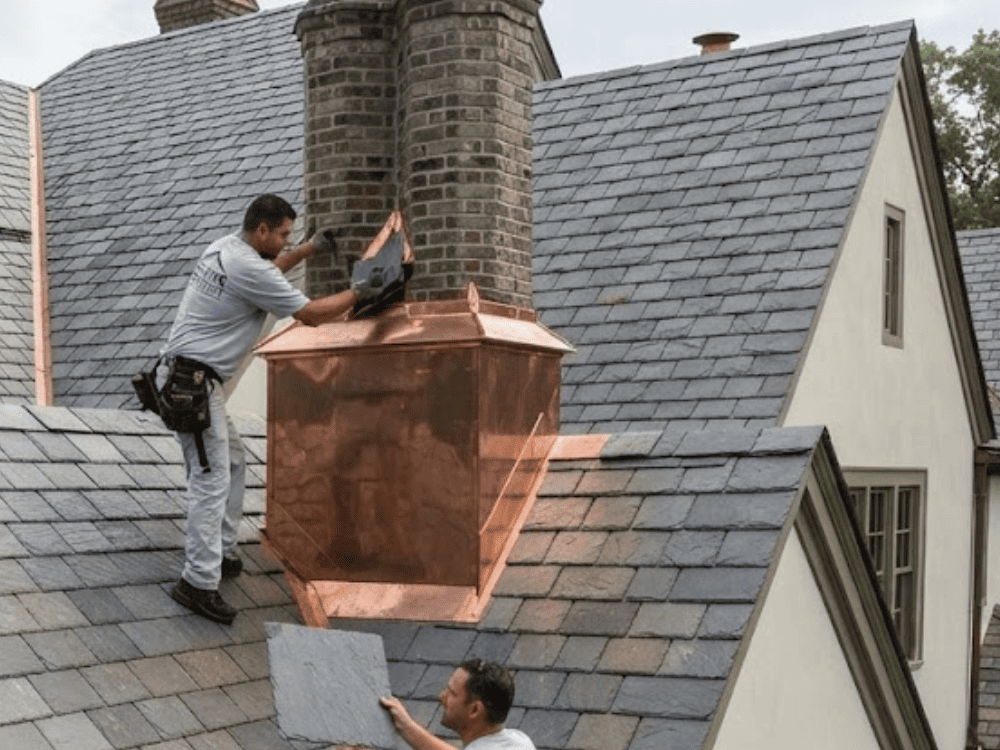
For most Long Island homes we install GAF Timberline HDZ or GAF Timberline UHDZ architectural shingles as part of a full GAF system, both carrying 50 years non-prorated on materials, transferable to the next owner, plus 25 years of workmanship backed by GAF. Where the house calls for something else, we install metal, cedar, slate, membrane or solar instead.
How A Residential Roofing Project Runs
Call And Describe The House
Tell us the age, the house type, whether there is an active leak, and what prompted the call. We schedule an inspection with an arrival window rather than a vague morning.
Inspection, Photographs And Written Price
We walk the roof, check the attic and the ventilation, and send photographs of every finding with a line-item estimate. Decking is priced per sheet before anything starts, so there are no change orders later.
Permit, Protection And Installation
We file the permit with your village or town, or through the NYC Department of Buildings in Queens. Landscaping, siding, AC units and driveways are protected, then the roof goes on in one clean pass.
Cleanup, Walkthrough And Warranty
Magnet sweep across the property, debris hauled away the same day, a final walk with you, the municipal inspection closed by us, and the manufacturer warranty registered.
What You Get When We Work On Your House
A roof replacement is loud, disruptive and expensive, and it happens to the place you live. These are the commitments that matter on a house specifically.
The estimate is the invoice.
Decking priced per sheet in advance and photographed as it is replaced. No allowances that quietly expand once the roof is open.
One crew, from inspection to cleanup.
All 21 of them ours. The person who measured your roof is on site the day it goes on.
Your property is protected before the first shingle comes off.
Landscaping, siding, windows, AC units, decking and driveway. Then a magnet sweep across the whole yard afterward, because you have children and pets and the driveway is where the car goes.
Photographs you keep either way.
Deck, flashing, attic and every replaced sheet. Take them to two other contractors. We would rather you compared than took our word.
The Long Island Homes We Work On
This island was built in waves and each wave left its own roofing problem behind. These are the house types our crews are on most weeks.
- Postwar capes in Levittown, Hicksville, Massapequa and Bethpage, where the rear addition is nearly always where the trouble sits
- Ranches in Oceanside, Baldwin, Wantagh and Seaford, where blocked soffit intake is the recurring story
- Split levels and hi-ranches across Merrick, Bellmore, Commack, Hauppauge and Medford, where the step flashing at the wall junction has been caulked and re-caulked for years
- Colonials in Garden City, Rockville Centre, Mineola, Smithtown and Setauket, where the chimney and the dormer valleys decide the scope
- Waterfront and coastal homes in Long Beach, Island Park, the Rockaways, Southampton and Montauk, where the hardware specification matters as much as the covering
Residential Roofing Questions Long Island Homeowners Ask
Living through the work, timing, payment and disruption. These five come up on almost every home estimate.
Do I need to be home while my roof is replaced?
No. We need driveway and side yard access for the dumpster and staging, and we need to get into the attic at the inspection stage, but you do not have to take the day off. It is loud and there will be vibration through the ceilings, so plan for pets and anything fragile hanging on walls.
How long will my roof replacement take?
One to two days on site for most Long Island houses with a single layer, and two to three for a two-layer tear-off or a steep, cut-up roof. Weather moves the date rather than the duration, and we will not open a deck we cannot close the same day.
Will the crew damage my landscaping or leave nails in the yard?
Protection goes down before the tear-off starts: landscaping, siding, windows, AC units, decking and driveway. Afterward we run a magnet sweep across the yard and the drive. If you find a nail later, call the office and we come back, which is a considerably easier conversation with a local company than with one that left the county.
What time of year is best to replace a roof on Long Island?
Late spring through fall is the widest window and also the busiest, so lead times are longer. Winter installs work perfectly well here on days above freezing and often schedule faster. What we avoid is genuinely cold conditions where the shingle sealant strips will not activate until the weather turns.
Do I have to pay for the whole roof upfront?
No. Financing is available up to 100% of project cost, subject to credit approval, and there is no deposit required to get an estimate. The estimate itself is free, itemized and yours to take to other contractors.
Get A Straight Answer On Your Home's Roof
Free inspection, photographs of everything we find, an itemized written estimate, and a 50-year transferable warranty on GAF shingle systems. Financing available up to 100% of project cost, subject to credit approval, plus $500 off a full replacement and our military and government employee discounts. Bluemaster Roofing serves Nassau County, Suffolk County and Queens from 141 Main Street, East Rockaway, NY.