24/7 Emergency Roofing In Long Island, NY Call And We Move
If water is coming into your house right now, call 516-405-5590. Someone answers, at any hour, any day. Bluemaster Roofing runs emergency response across Nassau County, Suffolk County and Queens from our office at 141 Main Street in East Rockaway, with our own crew and our own equipment. The first job is stopping the water and making the roof safe. Everything else, including what caused it and what it costs to fix properly, comes after the house is dry.
Request A Free
Emergency Roof Response


Emergency Roofing Work We Handle
Everything below is stabilization, done to stop damage and make the building safe. Permanent repair follows as a separate, properly quoted job once the weather clears.
Emergency Roof Tarping
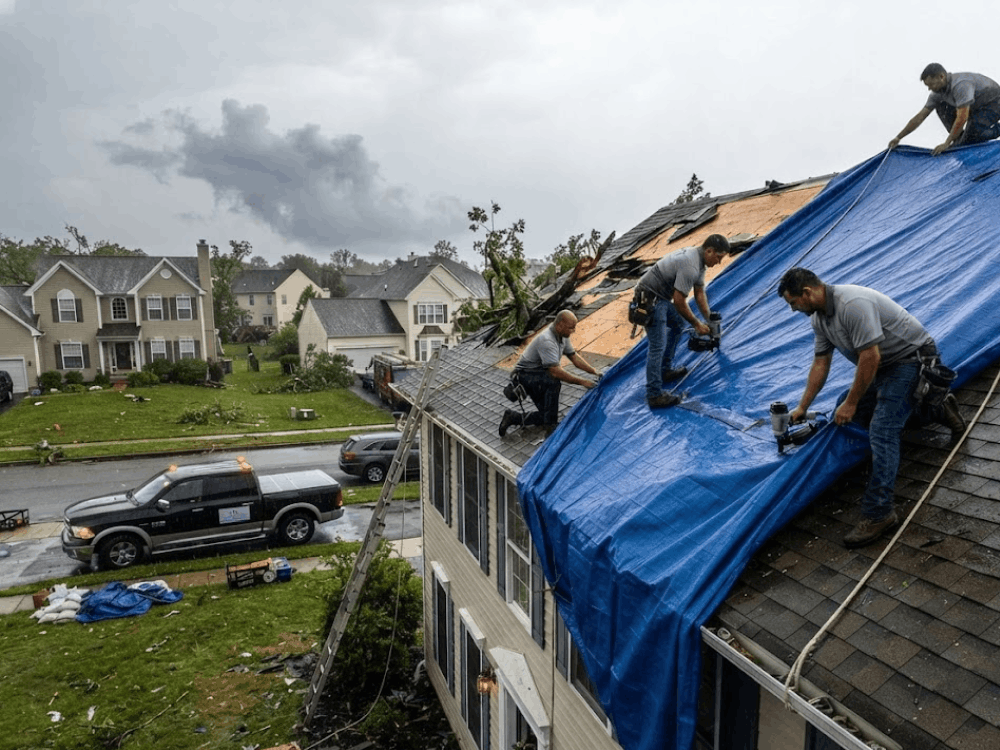
Heavy-duty tarp fitted over the affected area and secured to hold in wind rather than draped and weighted. Sized to cover the damage and run over the ridge where the exposure calls for it.
Storm And Wind Damage Response
Missing shingles, torn ridge cap, lifted membrane edges and stripped slopes after nor’easters and coastal wind events, made watertight the same visit.
Active Leak Stabilization
Water traced and stopped at the entry point where that is possible in the conditions, with interior containment set up where it is not.
Tree And Impact Damage
Debris removed safely, the opening covered, and the structure assessed underneath before anyone declares the building sound.
Flat And Low-Slope Emergency Work
Membrane tears patched, seams and terminations resecured, blocked drains cleared, and standing water managed on commercial and low-slope roofs.
Insurance Documentation
Photographs of the damage before anything is touched, dated, with a written scope your adjuster can work from.
What Counts As A Roofing Emergency?
A roofing emergency is water actively entering the building, or a roof that has been physically opened by wind, impact or fire. Everything else, including a stain that has been on the ceiling for weeks, is urgent but not an emergency. The difference matters because emergency response is priced for the hour it happens.
Call immediately:
- Water is coming through a ceiling or down a wall right now.
- A section of roof is gone.
- A tree or large limb has come down onto the roof.
- A ceiling is sagging or bulging.
- Storm debris has punctured the roof.
Today we stop the water. The roof comes later.
People put off calling because they think an emergency call means deciding about a whole roof tonight. It does not. These are two separate jobs, and only the first one is urgent.
Stop the water
We take the details on the phone
We get there and find the source
We make it watertight
We photograph and document everything
Timeframe
Hours, not days
Fix the roof
We take the details on the phone
An honest answer on repair or replace
A written line-item estimate
The permanent repair, when you are ready
Timeframe
Days or weeks, your call
Tarping is not a repair, and we will not pretend it is
A tarp buys you a dry house. It does not fix anything, it will not last the season, and any roofer telling you otherwise is not being straight with you. What it does is take the panic out of the decision, so the actual repair gets made in daylight, in decent weather, after somebody has looked at the whole roof.
Long Island policies also frequently carry a percentage-based windstorm deductible rather than a flat figure, which can run into thousands. We document everything either way, and we will tell you honestly whether a claim is worth filing before you make one.
Under 10 miles
10 to 25 miles
Further out
- Answered 24/7
Do this right now
1
Do this first
Kill the power to that room
If water is anywhere near a light fitting, a ceiling fan or an outlet, switch that circuit off at the panel before you do anything else. Water travels along wiring. Do not touch the fitting to check.
2
Sounds wrong, is right
If the ceiling is bulging, pierce it
3
Get a container under it, and a towel under that
4
Move everything out of the way
5
Photograph everything before you clean up
6
Check the attic if you can reach it safely
X
Do not get on the roof
What Happens From Your Call To A Dry House
You Call, A Person Answers
Any hour. We ask what is happening, whether water is actively entering, whether anyone is in the affected rooms and whether power near the leak is a concern. That determines what we send and how fast.
Documentation Before Anything Is Touched
Photographs of the damage in its original state, dated. This is the step most likely to be skipped and the one that matters most if a claim follows.
Stabilization
Tarping, patching, debris removal, drain clearing or interior containment, whatever the situation calls for. The goal is a building that is dry and safe, not a finished roof.
The Permanent Repair, Scheduled Properly
Done in daylight and dry conditions by the same crew, with the tarp fasteners closed and the actual cause fixed rather than covered.
Emergency Response For Long Island Homes & Businesses
Residential Roofing
Capes, colonials, split levels, ranches and waterfront homes across Nassau, Suffolk and Queens. Tarping, storm damage stabilization, tree impact response and interior containment.
Commercial Roofing
Storefronts, co-ops, medical offices, restaurants and warehouses. Membrane tears, seam and termination failures, blocked drains and ponding on Carlisle TPO and EPDM systems, handled to get you trading again.
Other Roofing Services We Provide Across Long Island
Once the house is dry, these are the services that finish the job properly, all handled by the same in-house crew.
Roofing Systems We Work On In An Emergency
Stabilizing a slate roof, a cedar roof and a TPO membrane are three different jobs. Tell us what is up there when you call and the right materials come on the truck.
What Does Emergency Roofing Cost?
Emergency work is priced differently from scheduled work, and it is fair to know why before you call rather than after.
What moves the emergency number:
Time of day and conditions.
A Tuesday afternoon call and a 2am call during a nor’easter are different jobs with the same description.
How much area needs covering.
One tarp over a single slope, or multiple sections after a tree came down.
Access and height
Three stories, steep pitch, no driveway, a tree still lying across the roof. Access drives emergency time more than anything else.
Whether the roof can be worked safely at all.
If conditions force interior containment and a return trip, that is two visits.
What You Get From A Bluemaster Roofing Emergency Call
Storm season brings a lot of trucks to Long Island that were not here in June and will not be here in December. These are the things that separate a local emergency response from that.
We were here before the storm and we will be here after it.
Our office is at 141 Main Street in East Rockaway, permanently. If something is wrong with the repair in year three, you are calling the same building.
A real arrival window, including when it is bad news.
During a major event we will tell you it is six hours if it is six hours. A contractor who promises everyone thirty minutes during a nor’easter is lying to most of them.
Documentation before we touch anything.
Original-state photographs, dated, in a format an adjuster can work from. Once a tarp goes on, the evidence is under it.
Our own crew and our own insurance.
Not a storm-chasing subcontractor recruited that week. You can ask for our certificates and we will send them.
Who We Respond To
Emergency response looks different depending on what is under the roof and who has to be told. Say which of these you are when you call and it changes what we send.
- Homeowners with active leaks. Single-family properties across Nassau, Suffolk and Queens, at any hour, including during and immediately after named storms.
- Landlords and property managers. Tenanted properties where response speed and documentation both matter, reported per address for owner records.
- Retail and restaurant operators. Storefronts and kitchens where a leak closes the business. Stabilization prioritized around reopening rather than around the roof.
- Medical, dental and veterinary practices. Buildings with equipment, records and patients underneath, where containment matters as much as the roof work.
- Municipal and public buildings. Emergency response with documentation and reporting formatted for procurement and public records.
Emergency Roofing Questions Long Island Homeowners Ask
These are the questions people ask while the bucket is still filling. Short answers, because you are busy.
How fast can you get here?
It depends on the weather and the queue. On a normal day, most of Nassau and western Suffolk is a short run from East Rockaway. During a major nor’easter, when three counties call at once, everyone has a wait, and we will give you a real window rather than a comforting number. Actively spreading water and electrical risk move you up the list.
Does homeowners insurance cover emergency roof tarping?
Most policies include an obligation to prevent further damage after a covered loss, and reasonable emergency measures are typically part of that. Keep the invoice and the original-state photographs. Being straight with you: if the underlying roof was already past its service life, the carrier may treat the damage as wear rather than storm loss even while accepting the mitigation cost.
How long will a tarp last on my roof?
Weeks, not months, and less on an exposed South Shore or fork-side roof in winter. A properly battened tarp will hold through normal weather, but UV and repeated wind will work on it. Treat it as a bridge to the permanent repair, and if that repair is going to be delayed, tell us so we can check the tarp.
A contractor knocked on my door after the storm. Should I use them?
Be careful. Post-storm door-knocking on Long Island brings in a lot of out-of-area operators. Before signing anything, ask for a local street address, a license and insurance certificate, and check they were operating here before the storm. That applies to us as well, and we will send you the certificates if you ask.
Do you handle emergencies on flat and commercial roofs?
Yes. Membrane tears, seam and termination failures, blocked drains and ponding after heavy rain, on TPO, EPDM and modified bitumen systems. Emergency patching is done with membrane-compatible products, because incompatible sealant can damage the membrane and put a manufacturer warranty at risk.
Water Coming In? Call Now, Not In The Morning
We answer 24 hours a day, every day. Bluemaster Roofing responds across Nassau County, Suffolk County and Queens from 141 Main Street, East Rockaway, NY, with our own crew, full documentation for your insurer, and no replacement pitch while your ceiling is still wet.