Slate Roofing Service Long Island, NY | Tested Before It Is Condemned
A slate roof can last a century, and a great many of the ones being replaced on Long Island did not need to be. What usually fails first is the flashing, the valley metal or the fasteners holding the slate, none of which is the slate itself. Bluemaster Roofing repairs, restores and installs slate across Nassau County, Suffolk County and Queens. We test the slate before quoting anything, because condemning a sound roof is a sales decision rather than a structural one.
Request A Free
Request A Free Slate Roof Assessment


Slate Roofing Work We Handle Across Long Island
Most of what we do on slate is repair and restoration rather than replacement, which is the opposite of how this material is usually sold.
Slate Condition Assessment
The slate sounded across every slope, flashings and valleys inspected, decking and framing checked, and a written report telling you what is actually failing.
Slipped And Broken Slate Replacement
Individual slates refixed with stainless hooks or the traditional bib method, matched from salvage wherever possible.
Valley And Flashing Restoration
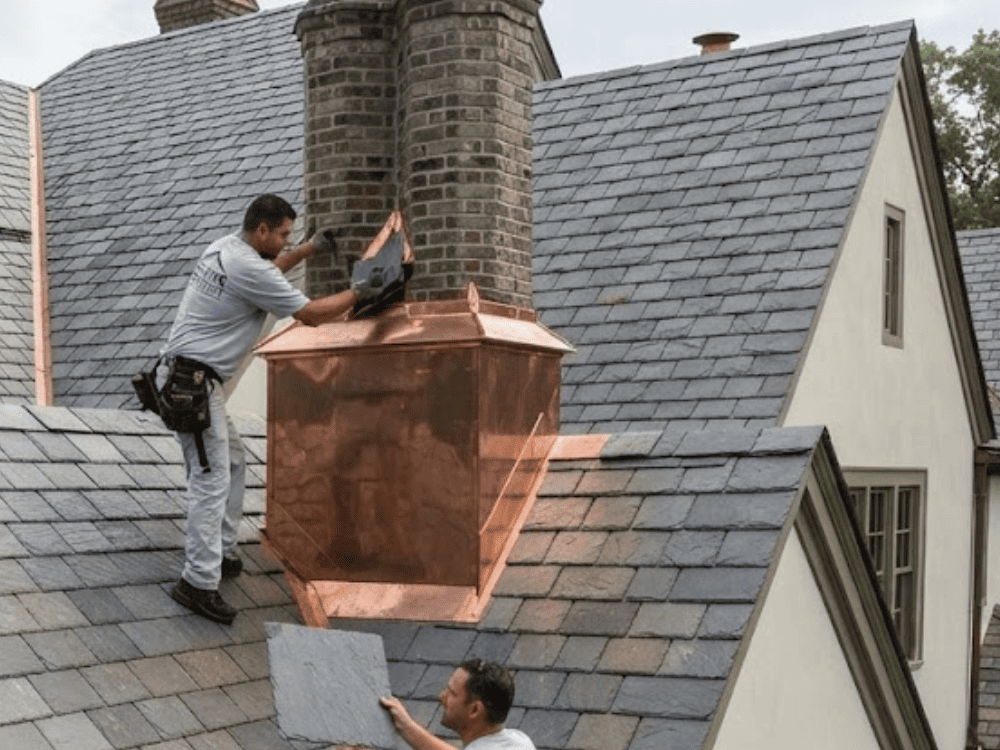
Copper valleys, chimney and sidewall flashing replaced on an otherwise sound slate roof, which is the most common genuine fix on a Long Island slate house.
Full Slate Re-Roof
Complete removal with sound slate salvaged and sorted, deck and framing assessed, then new or reclaimed slate laid with copper fasteners and flashing throughout.
Synthetic Slate Conversion
Where weight, budget or framing makes natural slate impractical, including handling architectural review submissions where a district requires approval.
Removing Bad Previous Repairs
Roofing cement, asphalt patches and face-nailed slates taken out and redone properly, which on many older roofs is where the leaks actually are.
When You Need Slate Roofing In Long Island
Slate itself rarely wears out inside a human lifetime. What fails is everything around it: the nails holding it, the copper or lead in the valleys, the chimney flashing, and occasionally the decking underneath. A slate roof with sound slate and failed flashing is a repair job, and it will be a fraction of what a tear-off costs.
- Slipped and missing slates.
- Leaks at valleys, chimneys and dormers.
- Delamination and flaking.
- Slates that sound dead when tapped.
- Previous repairs done in the wrong material.
Before You Tear It Off
Is the slate finished, or are the nails?
Slate lasts 80 to 150 years. The nails and flashing holding it last 30 to 50. So when slates start sliding off a hundred-year-old roof, the slate is usually sound and the fixings have failed. That is a repair job, not a replacement, and the two get confused constantly.
80 to 150
Years a natural slate lasts
Slate is stone. It does not wear out the way a manufactured product does.
30 to 50
Years the nails and flashing last
2 to 3
Sets of fixings a slate roof will outlive
The ring test tells you almost everything
Hold a slate loosely at one corner and tap it. A sound slate rings, almost like a tile. A failing one gives a dull thud. That single sound is the difference between a roof with decades left and one that is genuinely spent.
It takes seconds, anyone can hear the difference, and it is the first thing a contractor who actually works with slate will do.
Which one is your roof?
- Signs it is repairable
Slates are sliding off intact
Whole, unbroken slates on the ground means the nails let go, not the stone.
Leaks are at valleys or the chimney
Flashing, not field. Replaceable without touching most of the roof.
Fallen slates ring when tapped
Pick one up off the lawn and test it. If it rings, so does the rest of the roof.
Gaps are scattered, not clustered
A slate here and there across the roof is normal attrition over a century.
The attic shows rust, not rot
Corroded nail heads with sound decking is the classic nail sickness picture.
- Signs it is genuinely spent
Slates are flaking into layers
Delamination. The stone itself is breaking down and no fixing will hold it.
They crumble or snap in your hand
If a fallen slate breaks easily, its neighbours are the same age and condition.
Widespread cracking on every slope
Not scattered losses, but visible failure across the whole roof at once.
Soft or sagging decking
Felt from the attic. Water has been getting in long enough to reach the structure.
Previous repairs used the wrong slate
Mismatched thickness stresses the courses around it and spreads the damage.
Mostly left-hand column and you are looking at a repair, usually re-nailing, reflashing and replacing individual slates. Three or more on the right and replacement becomes the honest answer.
A contractor who cannot repair slate will always recommend replacing it. Not out of dishonesty, but because tearing off and installing asphalt is work they know how to do, and slate repair is not. Ask whoever is quoting you how many slate repairs they did last year.
The Craft
What does slate repair actually involve?
Four things, and none of them are how an asphalt roof gets fixed. Matching salvaged slate, removing a broken one with a slate ripper, fixing the replacement with a hook because you cannot nail there, and flashing in copper rather than galvanized. Use these to judge anyone quoting you.
1
Matching salvaged slate
Colour, size and thickness all have to match the existing courses. A new slate next to hundred-year-old ones stands out immediately, and a thicker one stresses the slates around it until they crack too.
How to tell
2
Removing with a slate ripper
A broken slate is held by nails hidden under the course above. A ripper slides up beneath it, hooks each nail and shears it. Prying a slate out instead breaks the three slates around it, which is how a two-slate repair becomes a ten-slate one.
How to tell
3
Fixing with a hook, not a nail
How to tell
4
Copper flashing, never galvanized
Slate lasts a century. Galvanized flashing lasts twenty-five years. Put them together and you have built a roof that needs opening up three more times before the slate is anywhere near finished. Copper is matched to the material it is protecting.
How to tell
One more thing that separates slate work from roofing work
Natural Slate, Salvaged Slate Or Synthetic?
Natural quarried slate is the original material and lasts longest. Salvaged slate is reclaimed material used to repair or restore an existing roof so the result matches. Synthetic slate is a composite product that looks similar at a fraction of the weight, which matters on framing that was never designed for stone.
How A Slate Roof Project Runs
Assessment And Sounding
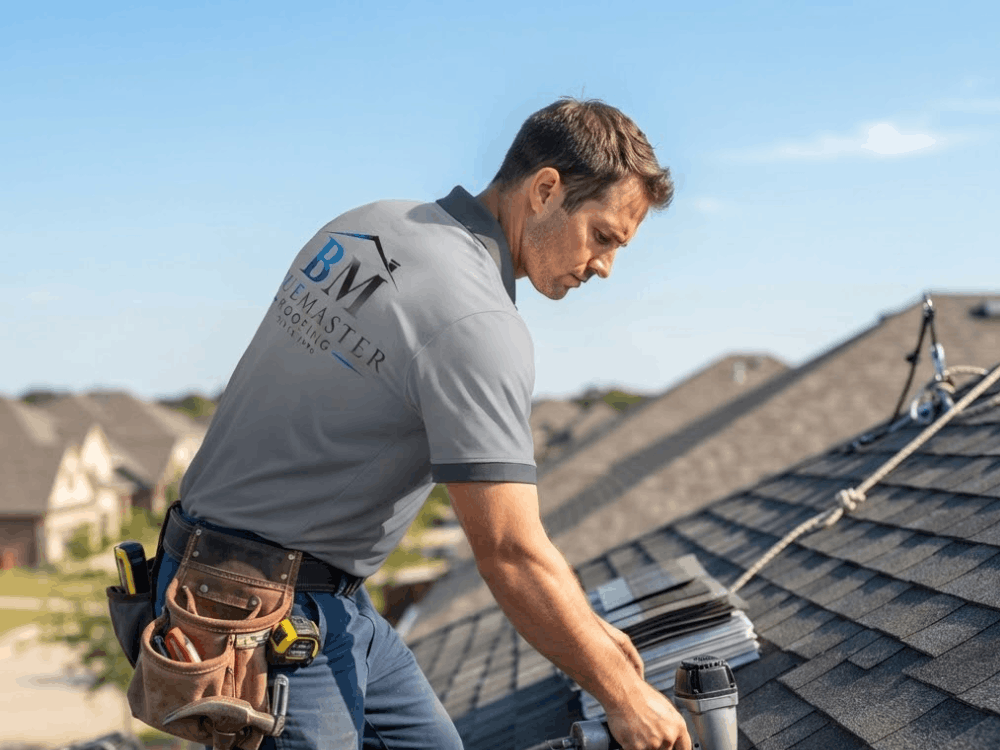
We get on the roof with proper access equipment, sound the slate across every slope, examine the valleys, flashings and fasteners, and check the deck and framing. Then we tell you whether you have a repair, a restoration or a replacement.
Written Specification And Estimate
Scope named line by line: which slopes, which slates, what metal, whether salvage is being used and where it is coming from. If the answer is a repair, that is what you are quoted.
Repair, Restoration Or Re-Slate
Work carried out with slate-specific access, copper fasteners and formed copper flashing. On a full re-slate, sound original material is salvaged and sorted rather than skipped.
Cleanup, Walkthrough And Warranty
Debris removed, property swept, final walk with you, permit inspection closed where one applies, and workmanship and any manufacturer warranty documented.
Slate Roofing For Long Island Homes And Buildings
Residential Roofing
Tudors, pre-war estates and period colonials across Nassau, Suffolk and Queens. Slate repair, copper valley restoration, full re-slating and synthetic conversion.
Commercial Roofing
Churches, schools, civic and institutional buildings with original slate. Documented scope for boards and committees, phased where a budget runs across years.
Other Roofing Services We Provide Across Long Island
Every service below is available across Nassau, Suffolk and Queens, handled by the same in-house crew.
Roofing Systems Install
Slate belongs on the houses that were built for it. For everything else, one of these five will suit better. We install and warranty all six.
What Determines The Cost Of Slate Work
A slate repair, a valley and flashing restoration, and a full re-slate are three different orders of magnitude. Establishing which one you need is the whole point of the assessment, and it is why we will not quote slate from a photograph.
Scope, above everything.
Replacing twenty slipped slates is a day. Replacing every valley and chimney flashing on a large Tudor is a project. A full re-slate on a steep, cut-up roof is one of the largest residential roofing jobs there is.
Access and staging.
Slate roofs are steep, tall and cannot be walked on freely. Roof ladders, hooks and scaffolding are a real cost and a real part of the timeline.
Material choice.
New quarried slate, salvaged slate and synthetic sit at very different price points, and salvage availability affects both cost and schedule.
Framing and deck work.
If the structure has deflected or the deck cannot carry the load, that is engineering and carpentry before it is roofing.
What You Get On A Slate Roof Job
Slate is the material where homeowners are most often oversold, because almost nobody can check the claim from the ground.
We sound the roof before we price it.
Slate that rings is slate with life left. That test decides the entire scope and it takes someone on the roof.
Copper fasteners and copper flashing.
Matched to the lifespan of the stone rather than to the lowest line on an estimate.
Salvage kept and reused
Sound original slate removed during work is sorted and stored for your roof, not skipped.
We say when it is a repair.
Repeatedly, and at cost to ourselves. A slate roof condemned early is the most expensive avoidable purchase in residential roofing.
Which Long Island Properties We Do Slate Work On
Slate on this island sits in specific pockets, mostly pre-war and mostly on the North Shore and in the older Queens neighborhoods.
- Tudors and pre-war estates in Great Neck, Manhasset, Port Washington, Roslyn and Glen Cove
- Period colonials in Garden City, Rockville Centre, Mineola and Westbury
- Queens historic neighborhoods including Forest Hills, Kew Gardens, Jamaica Estates and Douglaston
- North Shore harbor villages in Northport, Port Jefferson, Stony Brook and Setauket
- Churches, schools and civic buildings with original slate and a committee that needs documented scope
Slate Roofing Questions Long Island Homeowners Ask
Lifespan, repairs, matching and weight. These five come up on nearly every slate assessment.
How long does a slate roof last?
Natural slate is measured in generations rather than decades, with the exact span depending on the quarry source, the grade and the thickness. What almost always fails first is the copper in the valleys and flashings and the nails holding the slate, all of which are replaceable without touching the stone.
My contractor says my slate roof needs replacing. Should I get a second opinion?
Yes, and this is the one material where we say that emphatically. Ask whether they sounded the slate across the slopes and what they found. If the slates ring and the failure is at the valleys, chimneys or fasteners, you are looking at a restoration rather than a tear-off, at a fraction of the cost.
Can individual broken slates be replaced?
Yes. A slate is removed with a ripper and a replacement is fixed using a stainless slate hook or the traditional bib and nail method, without disturbing the surrounding courses. This is routine work, and it is one of the reasons slate ages better than any other roof covering.
Will a repair match the rest of my roof?
If salvaged slate is used, generally yes. New slate sits visibly brighter than hundred-year-old weathered material, which is why we match from reclaimed stock where the size, thickness and color can be sourced. We establish availability before quoting rather than discovering it on the day.
Is my house strong enough for a slate roof?
If it already has slate, yes, and the question is only whether the deck or framing has deflected over time. If you are adding slate to a house that never had it, the framing has to be assessed for the load first. Where it will not carry stone, synthetic slate gives a similar appearance at a fraction of the weight.
Get Your Slate Roof Assessed Before Anyone Condemns It
We sound the slate, check the copper, look at the deck, and tell you whether you have a repair or a replacement. Free assessment, photographs of every finding, and financing available up to 100% of project cost, subject to credit approval. Bluemaster Roofing serves Nassau County, Suffolk County and Queens from 141 Main Street, East Rockaway, NY.